
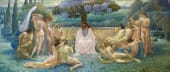
The Philosophic Life
What it looks like when you fall in love with wisdom


Philosophy is many things, but at its heart it is an invitation to a different kind of life—a life of freedom, wholeness, wellness, and dare I say it, happiness.
Philosophy (philo-sophia) means the longing for wisdom, a longing inherent in every human heart. In that sense we are all philosophers.
Being a philosopher is not a job title, nor is it a credentialed profession. Sure, to be a philosophy professor you need degrees and publications, but to be a philosopher? Not so much. The longing for wisdom is universal, and cuts across all barriers and boundaries. As human beings it is our nature to want to understand, to long for clarity, to endeavor to heal suffering, and to build interrelationships. The challenge is figuring out how.
Living the Philosophic Life
Wisdom is not a body of information. It is not correct doctrine. It is a way of being in the world—a way of life.
It is not an achievement, it is a process.
It is not a destination, it is a direction.
To live the philosophic life some new choices have to be made, and a few steps have to be taken—not perfectly, but earnestly, kindly, and graciously. This isn’t about instant transformation. This isn’t about self-aggrandizement. Nor is it about self-hatred or the exertion of control. It’s about setting a new course so that years from now you’re in a completely different and much better place. Even the slightest change amplifies over time.
It seems to me that the philosophic life is shaped by three core practices:
Step 1: Practice Self-Examination
Take the time to test all of your assumptions, understandings, and beliefs. Question everything you think you know—yes even that. With playful ruthlessness, take an unflinching inventory of your entire worldview. Be willing to risk everything—your positions, your affiliations, your reputation, your relationships, your citizenship, even your own comfort. This is about honesty, integrity, and accuracy. Wouldn’t you rather know nothing than believe in a lie? Wouldn’t you rather feel free and alive than be pinned to a cork board?
This will be more of a process of subtraction than addition. Instead of building up, you’re emptying out. As Laozi wrote in the Dao De Jing, “In the pursuit of knowledge every day something is added. In the practice of the Dao, every day something is dropped.”
Great philosophers like Laozi, Socrates, Buddha, and Descartes modeled this courageous inquiry and inspire us to follow suit. Without regular self-examination we too easily fall prey to self-serving assumptions and the temptation to go along to get along—two interrelated errors (egotism and conformity) that derail our journey to wisdom more than any other factors. It turns out our longing for love and community is capable of overriding our bullshit detector leaving us vulnerable to debilitating group-think. This affliction doesn’t care if you’re liberal or a conservative, atheist or a believer, vegan or an omnivore—we’re all susceptible to this weakness, a weakness that robs us of our liberty and autonomy. The goal is to get as close to the truth as possible, and that requires courage and the decision to cultivate the discipline of daily philosophical maintenance.
Step 2: Practice Humility
It’s difficult to break free from false ideas if you’ve already entangled your identity with them. When you marry together your self-image and self-worth with a particular set of opinions, a dangerous dynamic takes shape. When you identify with an ideology, and that ideology collapses under the weight of new evidence or its own internal contradictions, you ought to be able to let it slough off the way a snake sheds its skin—without any harm done to our sense of self and inherent value.
In fact, I would argue that the best scientists and philosophers actually enjoy finding out that they were wrong about something because it means that now, divested of their previous erroneous views, they are moving closer to the truth. And the truth is the only things that matters, not our foolish pride.
In simpler terms, stay humble. Keep these three holy words at the core of your worldview: I don’t know. Maintaining a healthy agnosticism strengthens rather that weakens us. The blade of grass is stronger than the oak because grass bends to let the wind pass, while the oak’s inflexibility makes topples over.
It’s never the wind’s fault.
In this same way, our belligerent attachment to our current worldview uproots us from the communal soil we share with all other living things. In our dogmatic obstinacy we become an enemy to humanity.
Practicing humility reanimates our interrelationships and roots us deeply into that which truly sustains us.
I might be wrong. Maybe I overlooked something. Maybe I rushed into that too quickly. There’s so much I don’t understand. I need to listen more and talk less. Maybe I should try seeing it through their eyes. This is what vibrant, life-giving humility sounds like.
Step 3: Practice Virtue
Simply put, being virtuous means becoming the best version of yourself.
Forget about perfection, forget about shame. Don’t compare yourself with anyone. Keep the focus inward. This isn’t a performance. There is no panel of judges. We are simply exploring the untapped strength, beauty, and power latent within us. As if midwifing the best version of ourselves is our sacred duty. Because it is.
Every tree seed contains an orchard or a forest—enough to feed and build a world. How much more is hidden within us?
None of us are isolated or bound by time. We are a moment on a continuum of becoming. We live both for the millennia of ancestors who came before us and made our life possible, and for those whose lives we shape going forward, all of us bound together by an inseverable chain of interconnectedness and interdependence. None of our choices are solely our own—they are shaped by, and go on to shape the lives of millions. This is both a daunting responsibility and an exalted opportunity.
In a word, virtue means excellence. For Aristotle, being virtuous or excellent required four things: rational capacity, willful decision making, consistent practice, and embodiment.
First we must train our intellects to do a better job of discerning truth from lies. This is no small feat. (See Step 1). We are all prone to indoctrination. Propaganda works only because it so effectively bypasses our rational minds and cuts right to the passions. It inflames our fear and plays our emotions like a toy piano. Self-examination and evidence-based rational thought are our best defense against intentionally deceitful propaganda.
Then when we have done our best to find a true path we must choose it again and again—make it a practice. As the Existentialists say, our life is a product of our choices. And as Buddha taught, our life is a product of our thoughts and actions. And as Aristotle argued, repeated actions become habit, and habit constructs character. We become what we do. After some time, (and no I don’t know the timetable), we will come to embody virtue. We will no longer have to struggle as much as we used to. Our practice will have worn a new rut in the ground for our wagon wheel to fall into. Old habits are replaced by new habits. What at first required strenuous effort gets easier. Our burdens grow lighter.
One simply has to recall one’s own learning process. Remember the first time you tried to tie your shoes? Ride a bike? Do algebra? Play guitar? Change and growth are not only possible, they’re inevitable—if we take action.
What if the acquisition of wisdom and the realization of virtue is just like that?
It is one of the most exciting things about being human—the realization that we are malleable. We are not carved from stone. Whatever hand we’ve been dealt, whatever conditions in which we find ourselves, we are not wholly formed at birth—we are shaped by environment, relationships, and choices. No matter how debilitating our genetics or early childhood environments, (there are so many things over which we have no power), we can now choose new environments, new relationships, and make new choices.
It turns out you can’t have everything you want, or be whatever you want to be, or become anything your heart desires. A compelling fantasy is not a contract with fate. Not everyone gets to be a rock star, an astronaut, or a Nobel Peace Prize Winner. We must work with what we have been given and within the limitations of our own mind and body. But it is also true that we can change and grow by cultivating the courage to uncover our hidden potentials. And therein lies our hope.
The Purpose of Philosophy
The practice of the philosophic life molds our innate restlessness into something purposeful. We have the capacity to live vivid and beautiful lives full of meaning, connection, and joy. Philosophy, if practiced, is a healing modality, moving us closer to the ideal. When we take perfection off the table, while leaning hard into stalwart optimism, the fog begins to lift. This isn’t all or nothing. It’s about gradually turning toward the light, and letting the Way show us where to go.
The purpose of philosophy is to enhance the quality of our lives—physically, psychologically, spiritually, materially—by tuning our instrument to its most harmonious and beautiful capacity. Loving wisdom is not only a gift we give ourselves—it is also the most immediate way to enhance the quality of life for others. To participate in the healing of the world—this is what our restless longing is asking for. Why would we ever let anything stand in the way of that?
Peter, For fear of sounding like a broken record, I've said it before and I'll say it again.... Thank you so much for your writing, your classes, your way of being in the world. This article speaks of so many things I've learned to become (and still learning to become) and have tried to put into practice over the past decade - practicing self examination, humility, and cultivating virtue. Everything you've written here flows into my marrow like a stream of water after a drenching rain, filling in the low spots after a dry spell. Also, because of you and others on SubStack, I'm beginning to write some short articles myself and though probably not many will read them, it helps me stay connected to myself. Namaste my friend.
Love this Peter. 😇